

Reps Are Asking AI. Are They Getting the Right Answers? Crayon Can Help
The world of competitive enablement is evolving fast, driven by the influx of AI tools entering the workplace. Sales reps and marketers are increasingly leaning on AI assistants like ChatGPT, Anthropic’s Claude, Microsoft Copilot, and enterprise search tools like Glean to get quick answers and insights. In fact, roughly 80% of companies now have some type of centralized AI initiative to boost employee productivity.
But there’s a catch: If your competitive intelligence content isn’t integrated into those AI tools, your teams could be getting generic, outdated, or just plain wrong answers about competitors. Reps may ask ChatGPT or Claude, “How do we beat Competitor X?” only to receive an incomplete response that doesn’t reflect your company’s real differentiation. The risk is clear – without your curated intel in the mix, AI could lead your team astray at the worst possible moments. Worst case, your enablement tech stack ends up siloed outside the new AI workflows and even faces budget scrutiny.
The solution is to plug your competitive insights into the AI tools your team already uses, ensuring AI-driven answers are accurate, context-rich, and deal-winning.
Why AI is Changing Sales Enablement:
AI-powered tools are changing how sales and marketing teams find and use information. Instead of searching through portals or PDFs, reps now expect to ask an AI assistant for help and get an instant answer. There's a huge opportunity: AI can sift through vast data to surface exactly what a seller needs – if it has the right data.
As Crayon’s team discussed in a recent webinar, sellers are indeed posing competitive questions to ChatGPT, Claude, and others – but those tools weren’t built for competitive selling on their own. They don’t inherently know your specific competitors, your product’s differentiation, or what actually wins deals. As Kelly Farrell, Senior Enablement Manager at Intercom, put it: “AI tools don’t know what’s true in a competitive deal—they echo what they find. Crayon helps shape the right story for sellers.”
This is why forward-thinking organizations are embedding competitive intelligence into AI. When integrated properly, AI can deliver on-demand battlecard snippets, competitor news, and tailored talking points, all in seconds. The impact is tangible: companies that connected their CI platform into AI workflows saw significant lifts in battlecard usage, better rep feedback, and higher adoption of compete content.
In one enterprise rollout, over 850 competitive questions were asked via an internal AI chat assistant in just 30 days. The answers powered by Crayon received the highest quality ratings, and battlecard usage didn’t drop – it increased. One product marketer noted that competitive answers powered by Crayon were rated 2.8x more helpful than the AI’s generic output.
APIs vs. MCP: Two Paths to AI Integration
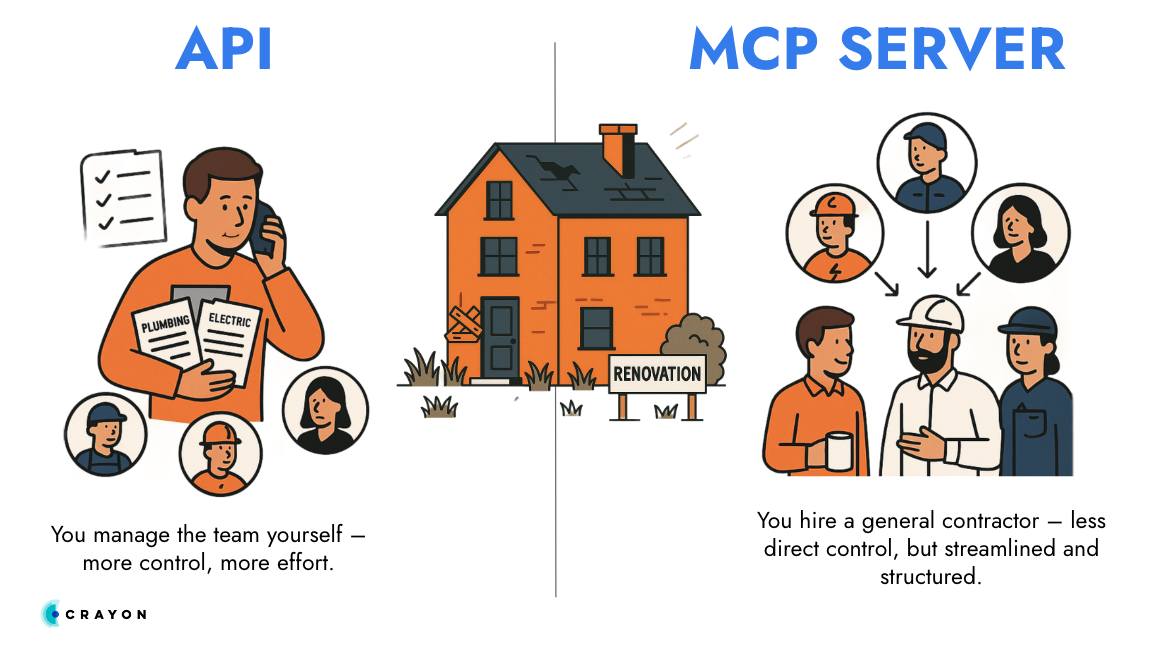
So how do you actually plug your competitive intel into these AI tools? In the webinar presentation we highlighted two key approaches: APIs and MCP servers. To make the distinction clearer, Jon White from Crayon offered a helpful metaphor: imagine you're renovating your house.
Using an API is like managing the whole renovation yourself, hiring the plumber, electrician, designer, and contractor individually. You get flexibility and control, but it takes more coordination and technical lift. Using an MCP server, on the other hand, is like hiring a general contractor who manages all the workstreams for you. It's faster to get started and easier to maintain, while still allowing customization.
APIs (Application Programming Interfaces): APIs act as a direct pipeline between your competitive intelligence and the AI assistant. With Crayon’s Content and Answers APIs, developers can pull curated battlecard content into AI tools, Slackbots, CRM widgets, and more. As Logan Hart from ZoomInfo shared, “We’ve connected Crayon via API to multiple internal tools. That’s been key to scaling competitive intel without needing a separate portal.”
MCP Servers (Model Context Protocol): MCP is a newer open standard that allows AI tools like Claude to fetch content from external data sources via a standardized interface. Crayon was the first CI platform to launch an MCP server, giving teams a plug-and-play way to make competitive content accessible to AI with minimal technical effort. As Kelly Farrell explained, “If you wait until after the AI platform launches, you might lose your seat at the table. It’s harder to get added later - it becomes an IT project.”
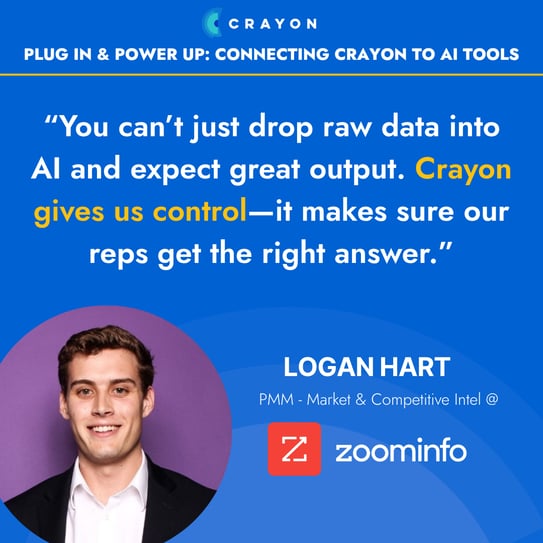
Whether via API or MCP, the goal is the same: make sure your AI assistant is drawing from your trusted competitive intel. In the words of Logan Hart, “You can’t just drop raw data into AI and expect great output. Crayon gives us control, ensuring our reps get the right answer.”
Delivering Competitive Insights in the Flow of Work:
Embedding Crayon into daily workflows is where the real value emerges. At ZoomInfo, reps get Crayon-powered answers inside Slack. “If they ask about a competitor,” Logan shared, “they get the exact talk track they need, right in the thread.”
At Intercom, connecting Crayon to Glean brought CI content into the company’s central enterprise search tool. “We push curated battlecard content into our enterprise AI tool, Glean. That way, reps get strong, consistent answers,” said Kelly. She added, “We don’t need to push people into Crayon daily—we just need Crayon to show up in Glean.”
These aren’t hypothetical use cases – they’re real examples of competitive enablement becoming smarter, faster, and more accessible through AI integration.
Check out the full webinar recording here to hear directly from Kelly Farrell (Intercom) and Logan Hart (ZoomInfo) as they walk through their real-world integrations of Crayon into tools like Glean, Slack, and internal AI assistants.
Embrace the AI Shift, On Your Terms
The evolving role of AI in competitive enablement isn’t about replacing human judgment. It’s about making sure your insights show up where decisions are made.
With APIs and MCP, Crayon customers are turning generic AI assistants into smart competitive allies. And thanks to leaders like Kelly Farrell and Logan Hart, we can see what the future looks like when CI becomes embedded in the flow of work.
If your reps are asking AI for help, make sure AI has your voice. Your message. Your differentiators.
Connect Crayon to Your AI Stack → Book a walkthrough!


Seeing is believing! Check out Crayon for yourself.

Related Blog Posts

Popular Posts
-
 Sales Battlecards 101: How to Help Your Sellers Leave the Competition In the Dust
-
 How to Create a Competitive Matrix (Step-by-Step Guide With Examples + Free Templates)
-
 The 8 Free Market Research Tools and Resources You Need to Know
-
 6 Competitive Advantage Examples From the Real World
-
 Crayon Launches First Competitive Intelligence MCP Server