

Sales kickoff season is right around the corner and that means pressure — pressure to deliver a session that isn’t just informative, but unforgettable. At our recent SKO webinar, Isaiah Crossman, broke down exactly how to train reps so they actually retain competitive knowledge and use it confidently on calls.
Below are the biggest takeaways from his session including frameworks, talk tracks, and exercises you can use in your own SKO.
1. Information Isn’t Enough, Reps Need Practice
Most competitive training stalls out because it relies too heavily on passive learning: showing a battlecard, presenting slides, or reciting talk tracks. Reps might absorb 10–20% of it—and then forget.
Isaiah highlighted the Learning Pyramid, a concept from the world of education that applies perfectly to sales enablement. The further down the pyramid you go, the more knowledge sticks.
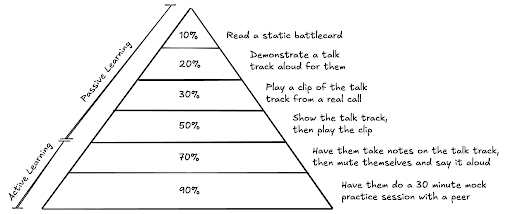
That means you need to move from:
- Reading and listening → Demonstrations → Guided practice → Peer teaching → Live application
When reps practice the talk tracks, say them out loud, or review each other’s work, retention skyrockets and so does competitive confidence.
2. Two Training Exercises That Actually Work
Isaiah shared two simple but effective live-training tactics you can run at SKO or in virtual team meetings:
Exercise #1: The Shared Google Doc Drill
Have reps watch a call clip or listen to a competitive prompt. Next assign each rep a tab in a shared Google Doc and ask them to write their talk track or response.
Why it works:
- Every rep participates, not just the vocal few
- You can add comments in real time
- It forces reps to process and apply the message themselves
- You instantly identify who “gets it” and who needs reinforcement
This moves your session deeper into active learning without requiring breakouts or complicated logistics.
Exercise #2: The Voice Memo Method
After demonstrating a talk track, send everyone on mute to record a voice memo of themselves delivering it (via Slack/Teams). Next, regroup and play a handful of examples.
Why it works:
- Reps speak the talk track making it far more likely to stick
- It reduces the fear of practicing aloud in front of peers
- You create instant coaching moments by reviewing submissions
This one is especially powerful for remote teams.
3. Train Reps to Differentiate Without Sounding Aggressive
One of the reasons reps avoid competitive talk tracks? They don’t want to sound like they’re bashing the competition.
Isaiah shared a framing that removes the awkwardness and instantly builds credibility:
Ask permission to differentiate.
When a buyer mentions a competitor:
“As we walk through things today, would it be helpful if I pointed out the specific areas our customers consistently say helped them choose us over Other Vendor?”
Almost every prospect says yes and suddenly your rep has full license to differentiate naturally, without sounding defensive or salesy.
4. Seed Differentiators Early (Before the Prospect Asks)
The best competitive sellers don’t wait for the “How are you different?” question. They plant differentiators proactively during discovery.
For example:
“One thing many of our customers value is the breadth of our integrations—happy to dig in as we go.”
Later, when a competitor comes up, the rep can tie back to that earlier point:
“This is actually one of the things we talked about on our last call…”
The differentiator now feels matter-of-fact and not like a scripted rebuttal.
5. Teach Reps the Five Discovery Topics That Unlock the Right Talk Track
Most companies have too many differentiators. Reps need a way to decide which ones matter for this buyer and this deal.
Train reps to ask discovery questions around:
- Where they are in the buying process
- Which competitors they’re evaluating
- What they liked/didn’t like so far
- How they plan to make their decision
- Which factors matter most (service level, cost, ROI, features, etc.)
Isaiah shared a plug-and-play discovery question you can copy into your SKO deck:
“As you compare the different options, which factors will be most important in your evaluation?”
This gives your reps “the answers to the test” so they can tailor their differentiation with precision.
6. Use Repetition to Reinforce Your Key Differentiators
Reps often lose deals and walk away confused:
“But I told them we had that feature! Why didn’t it land?”
Because saying something once isn’t enough.
Reps should repeat (and repeat again) their top differentiators naturally, not forcefully whenever buyers ask related questions.
Example: if service level is your differentiator, and the buyer asks about implementation:
“This is actually a great example of what many customers cite as a big reason they chose us — our service team makes implementation incredibly easy…”
You reinforce your advantage while still answering the question.
For more training tips and advice on SKO, check out the recording 👉 ‘From Kickoff to Close: How to Launch (or Relaunch) your compete program at SKO’


Seeing is believing! Check out Crayon for yourself.

Related Blog Posts


Popular Posts
-
 Sales Battlecards 101: How to Help Your Sellers Leave the Competition In the Dust
-
 How to Create a Competitive Matrix (Step-by-Step Guide With Examples + Free Templates)
-
 The 8 Free Market Research Tools and Resources You Need to Know
-
 6 Competitive Advantage Examples From the Real World
-
 Crayon Launches First Competitive Intelligence MCP Server