

Your competitive content is only as good as the data behind it. But the most valuable competitive data your company has is stuck in your reps' heads.
It's there right now: why the buyer almost walked, which objection actually mattered, the offhand comment that showed exactly where a competitor is weak. Your reps learn it in real time, on live calls, under pressure. Then they close the deal, exhale, and move on to the next one, and the lesson fades by Friday.
This is the quiet failure at the center of most CI programs. It isn't bad battlecards or slow monitoring. It's that the people who hold your best competitive intel are too busy selling to ever write it down.
Why win/loss capture keeps breaking
Every common approach runs into the same wall: timing.
Ask a rep to fill out the Salesforce fields after a close, and you're competing with their next call for attention. Even a diligent seller tends to leave a one-word answer in a box that deserved a paragraph, so the CRM holds a thinner version of what they actually know. Schedule a structured win/loss interview and you get real depth, but it often lands weeks later, once the rep is deep in next quarter and working from memory. Bring in a dedicated win/loss service and the depth gets better still, though the lag and the setup stay the same.
None of these are bad ideas. They just ask for the story long after it stopped being top of mind, through a process built for the database instead of for the person filling it out.
The rep isn't the problem, and neither is the method. The moment is. The richest detail is there the day a deal closes, and every one of these waits until after it has faded.
Catch the intel while the deal is still fresh
Field Agent for Slack flips the moment. Instead of chasing reps later, Crayon meets them at the close.
When a competitive deal moves to Closed Won or Closed Lost in Salesforce, Crayon pings the rep right in the Slack channel where your sales team already lives. On a win, it is a quick victory lap and an easy how'd-you-pull-it-off. On a loss, it asks the more valuable question, the one your CRM never really answers: what actually beat us? The rep replies in whatever way is fastest, usually a two-minute voice note on the way to the next call, sometimes a typed line or a screenshot. And it doesn't just take the first answer. If something is left open, the agent asks a sharp follow-up the way a good interviewer would, then lets them get back to selling.
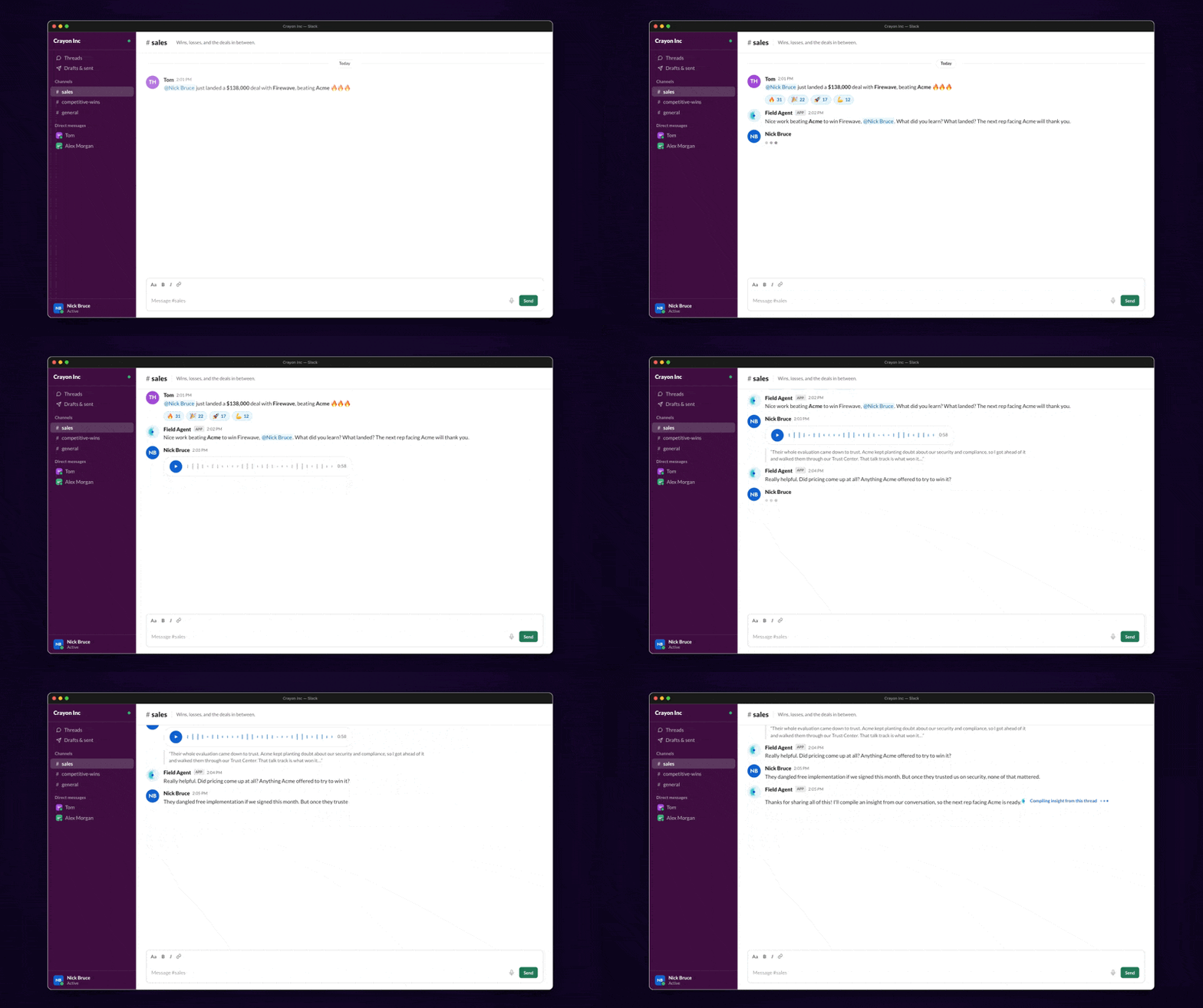
The voice note is the unlock. It is how reps already talk to each other, and it captures what a text box strips out. The pause before "honestly, pricing was a bigger deal than they let on." The specific landmine that closed it. The objection they almost lost to. That nuance is the intel, and it only survives in someone's actual voice, minutes after the deal.
It also lands where the team already is. The prompt shows up in the channel where reps are already reacting to the close, so replying feels like part of the moment instead of extra admin. Capture that fits the moment gets done. Capture that feels like a chore does not.
One voice note, and the whole program gets sharper
A voice note that sits in a thread is a nice moment. A voice note that feeds your program is an asset.
Crayon transcribes the note, runs it through competitive analysis, and turns it into a structured Insight. It pulls out the decision factors, the objections handled, the differentiators that landed, and the landmines worth planting next time. The Insight gets tagged to the competitor and linked straight back to the original thread, so the citation is the rep's own words.
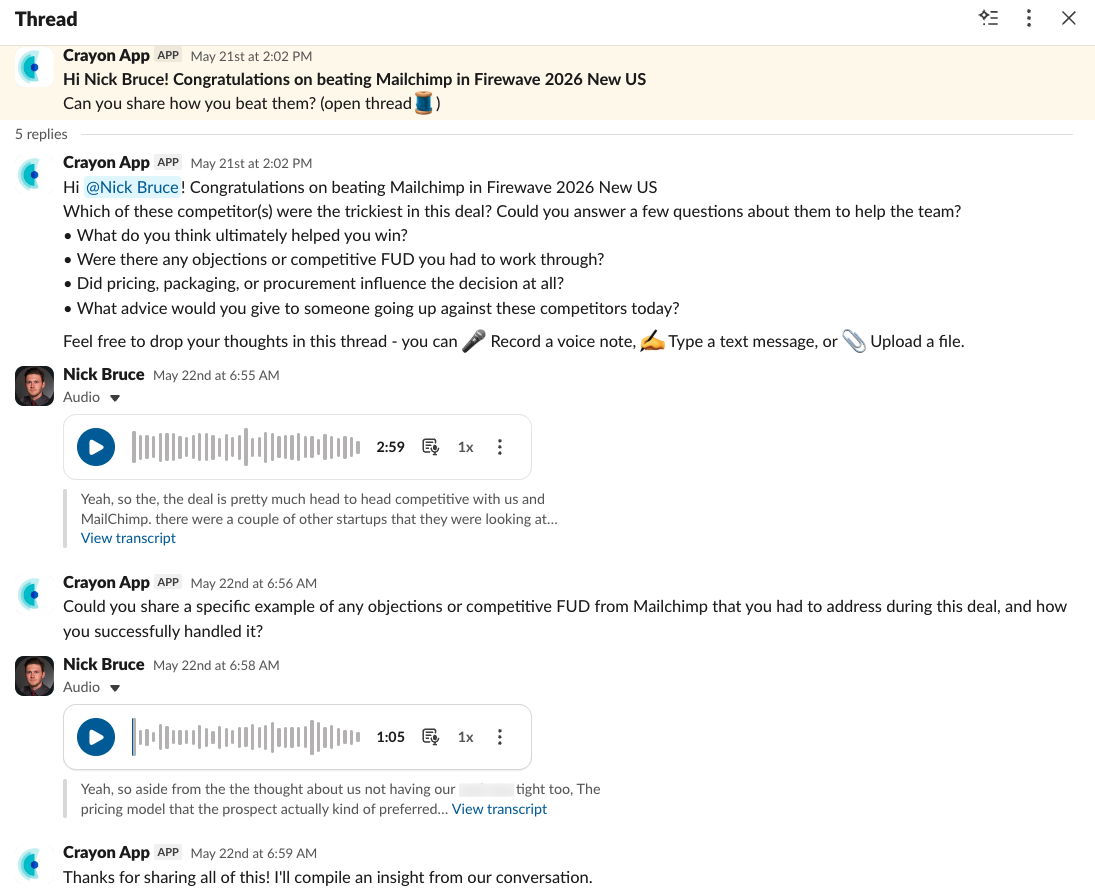
From there it compounds. Sparks pull from first-person field reasoning instead of web scraps. Battlecard tiles refresh with the exact phrases your top reps use to win. Answers cites a real rep on a real deal when the next seller asks how to handle a competitor. The raw material your battlecards always lacked starts arriving on its own, every time a deal closes.
What it looks like in practice
Mary just closed a competitive deal. The opportunity flips to Closed Won in Salesforce with the competitive flag set, and a minute later Crayon posts in her team's wins channel: congrats on the deal, this one was competitive, drop a quick voice note on how you won it.
On her walk to the next call, Mary taps record. Two minutes. She talks through the trial that turned the deal, the FUD the competitor tried to plant, how she walked the buyer through Crayon live, the pricing concession that landed, and a specific gap in the competitor's integration story that sealed it. Crayon thanks her in the thread and tells her it's been added.
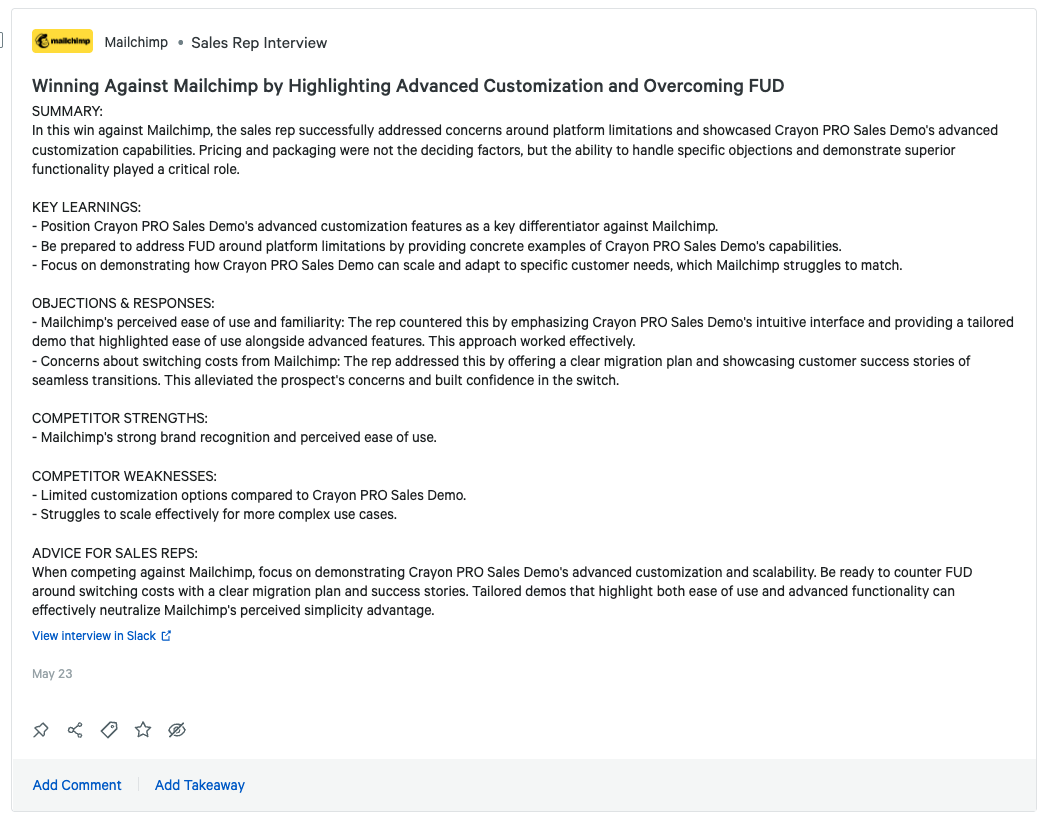
The next morning, the CI lead sees a clean Insight in the feed: decision factors, objections, the differentiator that worked, all attributed to Mary and linked to her note. They pull the differentiator into the competitor battlecard. Two weeks later, a different rep heading into a deal against that same competitor opens the card and reads Mary's actual reasoning, cited and ready to use.
That is the loop. Field intel in, sharper enablement out, no one chasing a form.
Intel that even your call recordings miss
Field-sourced win/loss used to require call recording to do well, so teams without it were stuck with whatever landed in the CRM. Field Agent removes that dependency. The capture path runs through Slack, so the quality of your intel no longer hangs on a recording subscription or a separate interview vendor.
The bigger unlock is for the teams that already record everything. A call clip shows what happened in the room with the buyer. It can't show the parts that decided the deal off the call: the follow-up email the rep and their manager rewrote until it landed, the pricing angle worked out in a hallway, the read on the buyer they never said out loud. The rep knows all of it. The agent just asks, and they tell you.
For a CI lead running lean, that changes the math. The program gets smarter on its own, sourced from the people closest to the deal, in the moment they know the most.
And here is the part no one can copy. What no general tool can reach is your reps' first-person account of why deals actually swing. It was never recorded or written down anywhere, so no competitor and no off-the-shelf AI can pull it. That is a real data moat, and it builds itself a little more every time a deal closes.
In a world where every team can point AI at the same websites and read the same reviews, that intel is table stakes. The edge left is the stuff only your reps know, and the team that captures it first wins. Field Agent is how you start capturing it, one deal at a time.


Seeing is believing! Check out Crayon for yourself.

Popular Posts
-
 Sales Battlecards 101: How to Help Your Sellers Leave the Competition In the Dust
-
 How to Create a Competitive Matrix (Step-by-Step Guide With Examples + Free Templates)
-
 The 8 Free Market Research Tools and Resources You Need to Know
-
 6 Competitive Advantage Examples From the Real World
-
 Crayon Launches First Competitive Intelligence MCP Server